Is Vaping Bad for Your Heart? What the Latest Research Shows

When e-cigarettes (commonly known as vapes) first emerged in the early 2000s, they were widely marketed as a safe alternative to traditional smoking, prompting millions to make the switch.
However, as clinical research has caught up with this trend, a more complex picture has emerged. While vaping exposes users to fewer toxic chemicals than combustible tobacco, it is far from a harmless practice. And so we ask: Is vaping bad for your heart?
Today, cardiologists are increasingly concerned about the physiological toll of e-cigarettes – particularly their hidden, long- term effects on the heart and cardiovascular system.


The Research On Vaping
“While research suggests that vaping may be less harmful for your heart than traditional cigarettes when used strictly as a tool to quit smoking, the reality is that we simply do not have the facts to know its long-term impact on cardiovascular health yet,” explains Dr Ricardo Petraco, Consultant Cardiologist at One Heart Clinic. “What is deeply alarming is the new risk we are seeing: young people taking up vaping without having previously smoked at all. In fact, around 70% of young adult vapers have never smoked. Businesses may be seen as capitalising on this demographic by marketing and selling vapes with bright colours and sweet flavours, effectively engineering a new public health crisis. The Government must tackle this issue now with taxation, flavour bans and a move to plain packaging, before the unknown, long-term effects of vaping become rife amongst younger generations.”
In this article, we will explore:
- What is currently known about the effects of vaping on cardiovascular health
- Nicotine and its health risks – even if it comes from a “cleaner” source like a patch or gum
- The differences between traditional cigarettes and e-cigarettes
- Who is most at risk of the heart health impact of vaping
- How quickly your heart can recover after you stop vaping
“Around 70% of young adult vapers have never smoked.”


Is Vaping Bad For Your Heart?
Yes, vaping does cause heart problems. While public perception often mistakenly equates "tobacco-free" with "healthy", and vapes are frequently marketed under the misconception that they are just harmless water vapour, the clinical reality is much more stark.
Nicotine acts as a direct cardiovascular toxin. Because of this, individuals who use e-cigarettes face 44% higher odds of suffering a myocardial infarction (or heart attack) compared to those who do not smoke or vape. The European Society of Cardiology
Consensus is definitive on this issue: absolutely no product containing nicotine is safe for your heart or blood vessels. Even without the combustion of traditional tobacco, the hemodynamic effects of nicotine actively drive cardiac events.
"Individuals who use e-cigarettes face 44% higher odds of suffering a myocardial infarction (or heart attack) compared to those who do not use them."


Nicotine & Heart Health: Vapes Aren't Just "Water Vapour"
Traditional cigarettes burn tobacco and produce smoke containing chemicals including tar and carbon monoxide (which are toxic and carcinogenic), while e-cigarettes heat a liquid usually containing nicotine, propylene glycol, vegetable glycerine and flavourings, to create an aerosol – not just water vapour, which is a common misconception.
Though this aerosol does not produce carbon monoxide and tar, it is not risk-free, and can contain irritant chemicals (like the breakdown products of propylene glycol and glycerine), formaldehyde and other carbonyls, volatile organic compounds and heavy metals such as nickel, tin and lead, which can damage the lungs and cardiovascular system.
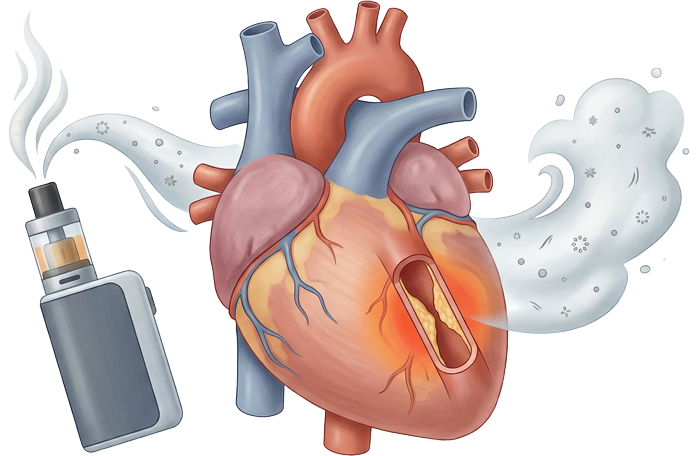
Not only that, but most vapes contain nicotine, which is highly addictive and puts the heart and cardiovascular system under stress. It does this in a variety of ways:
Raises heart rate by around 7-15 beats per minute and increases blood pressure shortly after use
Stimulates the sympathetic nervous system (fight-or-flight), releasing adrenaline and noradrenaline, which increase cardiac workload and oxygen demand.
Narrows the arteries, reducing blood flow and making the heart pump harder against higher resistance.
Damages the endothelium (the inner lining of blood vessels), leading to “endothelial dysfunction,” an early step in the hardening of the arteries (atherosclerosis).
Promotes inflammation in vessel walls and increases release of inflammatory messengers that accelerate plaque build-up.
Increases the risk of abnormal heart rhythms (arrhythmias) by raising catecholamines and directly affecting heart ion channels.
Can lower the threshold for dangerous ventricular rhythms and may contribute to sudden cardiac death in people with underlying heart disease.
Activates platelets and parts of the clotting system, making blood more likely to clot.
This higher clotting tendency, on top of narrowed, inflamed arteries, increases the chance of a heart attack or stroke when a plaque ruptures.
The danger isn’t limited to nicotine. The flavourings used in vapes – particularly aldehydes found in vanilla custard and cinnamon flavours – are not chemically inert. They are biologically active toxins that disrupt cell viability and increase apoptosis (cell death). In fact, these specific flavours show a toxicity index 13.6 times higher than clean air.
These nicotine effects occur regardless of how nicotine gets into the body (cigarettes, vapes, patches, gum), although smoked products add extra toxins, which create more risk factors for side effects.
For someone who previously smoked, switching to a “cleaner” nicotine product such as a patch or gum usually lowers overall heart risk because it removes smoke toxins, but continuing high-dose nicotine still keeps heart rate, blood pressure and vessel stress elevated compared with being nicotine-free.
“Flavourings used in vanilla custard and cinnamon-scented vapes show a toxicity index 13.6 times higher than clean air.”

Who Is Most At Risk Of The Heart Health Impact Of Vaping?
The example: At 65, this person has already had a small heart attack, which is often the wake-up that forces individuals to confront their habits. They have smoked for many years, so his arteries are already damaged and narrowed, and his heart has been pushed to its limit.
When they are told they have had a heart attack, they are suddenly highly motivated to change, but quitting smoking overnight feels impossible.
Vaping becomes a tool, not a new lifestyle: they switch fully from cigarettes to a vape, use it consistently for a few months, and, crucially, do not smoke at the same time. Over a year, they gradually reduce the nicotine strength, break the daily rituals of smoking, and eventually stop vaping as well.
What this means for their heart health: Dr Petraco explains, “This is the example of vaping used in the narrow, medically useful way many cardiologists hope to see: a temporary bridge away from smoking, not a long-term replacement addiction. His overall exposure to the toxic chemicals in tobacco smoke drops dramatically when he switches, and then drops again when he stops vaping altogether.
“For his heart, this means less ongoing damage to blood vessels, lower inflammation, and a reduced risk of another heart attack over time. He will likely never have a “normal” risk again because of his past smoking, but he has stopped adding fuel to the fire, and his heart now has room to stabilise and recover as much as possible.”
The example: Two children began vaping at school age, in a world where brightly coloured devices and sweet flavours are easy to find and heavily marketed on social media and in shops. They would never have seen themselves as “smokers”; in fact, they might look down on cigarettes as something old-fashioned or disgusting.
Vaping feels modern, social and fun - something you do with friends on the way to school. Very quickly, taking a few puffs becomes something they do in every break, before bed, or on the bus. They don’t notice that they are training their brains and bodies to expect nicotine all day.
What this means for their heart health: “From a heart health perspective, this is worrying,” Dr Petraco says. “The use of vapes means exposing otherwise healthy, developing bodies to nicotine and other chemicals for no benefit at all. Nicotine raises heart rate and blood pressure and can make blood vessels stiffer and more reactive; starting that process in early adolescence potentially brings forward the clock on heart and circulation problems in later life.
“Because they never smoked, there is no “harm reduction” here - only new harm created. There is also a real risk that, once they are dependent on nicotine, some will eventually experiment with cigarettes too, moving from vaping to dual use rather than the other way around.”
The example: A smoker begins with what sounds like a sensible plan: they decide to use vaping to cut down on cigarette use, and eventually stop.
At first, they may replace some cigarettes with a vape, telling themselves that every cigarette avoided is a victory. But instead of fully switching, they drift into a pattern: vaping indoors, at work or at home where smoking is not allowed, while still smoking traditional cigarettes when they are outside, with friends, or after meals. Over time, this becomes the new normal. They never actually break the habit of smoking; they simply add vaping on top.
What this means for their heart health: As Dr Petraco says, “For this person’s heart, this is one of the worst outcomes. Smoking continues to deliver all the known harms of tobacco – damage to artery walls, increased clotting, higher blood pressure, and toxic chemicals that directly injure the heart. Vaping does not remove those harms; it just adds more nicotine and additional chemical exposure into the mix.
“Many dual users also end up using nicotine more frequently throughout the day, keeping their heart and blood vessels under constant stimulation.
“Psychologically, they may feel that they are taking positive action because they vape, but this can delay a serious quit attempt for years. Instead of acting as a stepping stone away from cigarettes, vaping has become a crutch that keeps them tied to this habit.”
The next heart attack, the next stroke, the next cardiovascular death may not come from a cigarette, but from a flavoured pod, a nicotine pouch, or a waterpipe in a café. If Europe fails to act now, we will face the largest nicotine addiction wave since the 1950s.

The Dangers Of Dual-use: Smoking And Vaping
“Dual use” represents the absolute highest risk category on the spectrum of nicotine consumption.
Many individuals attempt to use vapes to quit smoking, but do not transition completely; instead, they end up consuming combustible toxicants from cigarettes alongside high-dose nicotine salts from vapes. This combination essentially stacks the biological stress on your body. Because of this compounded toxicity, dual users are over four times more likely to suffer a heart attack than non users. Ultimately, the public health goal of harm reduction completely fails if it leads to dual use.


Does Secondhand Vaping Cause Health Problems?
Yes, passive exposure to vaping carries real, invisible risk for bystanders:
- The sidestream aerosol produced by vapes is absolutely not just water vapour.
- When analysed, this aerosol is shown to contain a hazardous mix of ultrafine metal particles, reactive peroxides, and nicotine.
- When bystanders inhale this secondhand aerosol, it induces inflammation and introduces reactive oxygen species into their systems.
- Furthermore, even passive exposure to “smokeless” heated tobacco products has been shown to impair vascular function in non-users.
How Quickly Can The Cardiovascular System Begin To Recover After Stopping Vaping?
While the immediate benefits of smoking cessation are well-documented, the specific timeline for recovery following the transition away from e-cigarettes remains a subject of ongoing study.
Dr Petraco suggests that we can look to existing data on traditional cigarettes to understand potential healing. He notes that once a person quits, they can experience rapid “functional benefits” as the products stop interfering with the arteries’ ability to properly open and close.
He explains that by extrapolating what is known about the “endothelial dysfunction in the lining of the cells of the arteries,” we see that this damage often “stops within days or weeks after you stopped.”
However, he is careful to note that this comparison is not yet definitive, stating “When it comes to vaping, we don’t know yet – to the best of my knowledge – that there is evidence that the cardiovascular system recovers as quickly as it does after smoking cessation.”
Consequently, while medical experts remain optimistic, further dedicated research is essential.
Quit Vaping For Your Heart
While vaping is sometimes used as a temporary bridge to quit traditional smoking, it is far from a harmless practice. The clinical consensus tells us that absolutely no product containing nicotine is safe for your heart of blood vessels. Quitting both smoking and vaping entirely is the most important step you can take to stop ongoing damage to your arteries, reduce inflammation, and give your cardiovascular system the best possible chance to stabilise and recover.
Helpful resources if you are considering giving up smoking

Get An Understanding Of Your Heart Health
Because the strain that nicotine and e-cigarette chemicals put on your body often develops silently, you shouldn’t wait for physical warning signs to seek medical advice. If you currently smoke or vape, or if you have a history of using these products, we highly encourage you to book an exploratory consultation or consider our packages, to get an understanding of your current heart health. Even if you are not experiencing any cardiovascular-related symptoms, a proactive assessment can give you a clear picture of your heart health and provide expert guidance on your journey to becoming completely nicotine-free.
Discover more